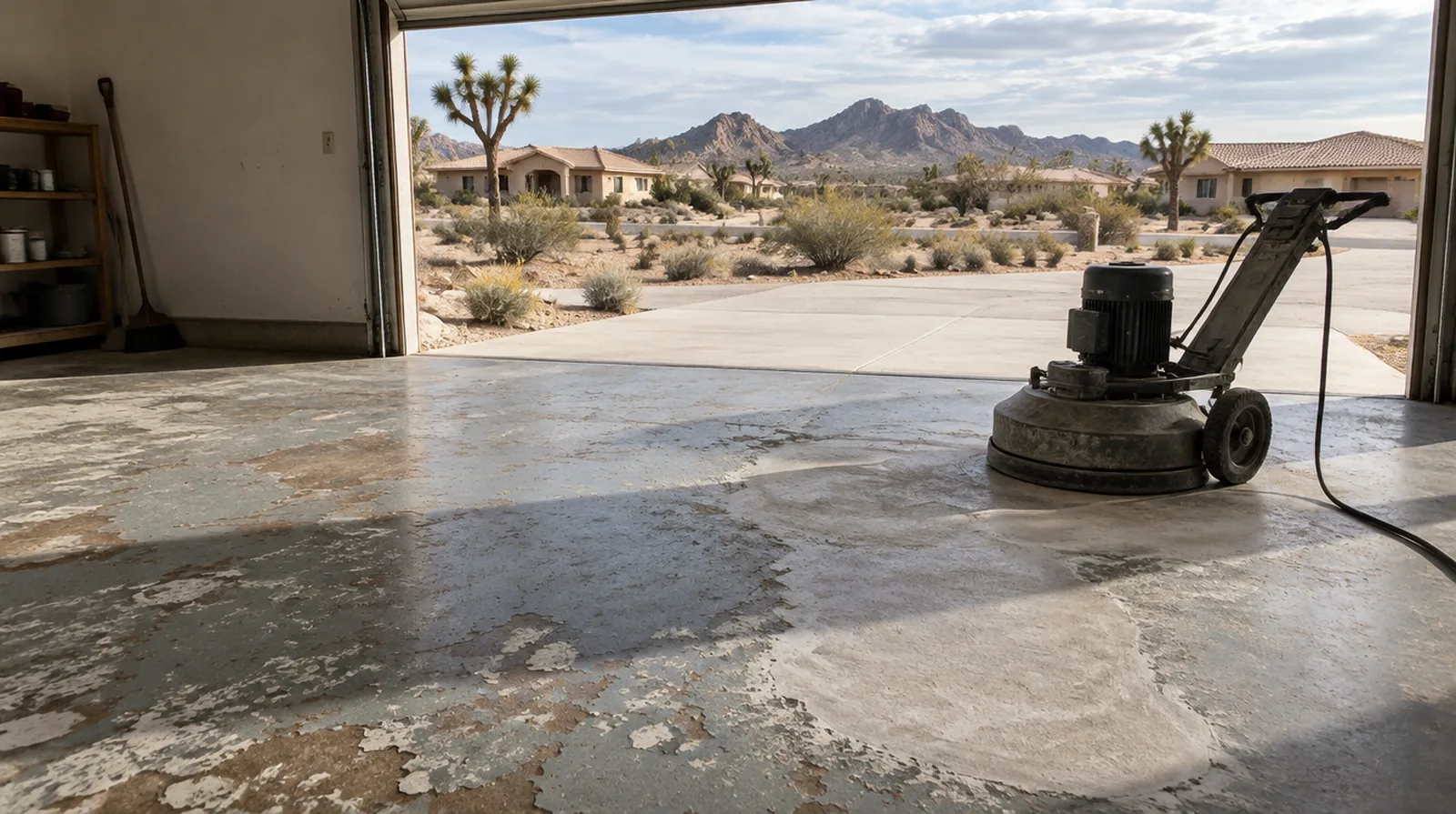
Why floors fail here
- No grinding: kit coatings rolled over etched or dusty concrete lift under hot tires.
- Moisture: even in the desert, water can wick up through a slab without a vapor barrier.
- Sun damage: clear epoxy that faces the sun can chalk and yellow.
- Thin coats: one coat of paint-like epoxy wears through quickly.
How we fix it
We look at why it failed first. Small chips can be patched and blended. Wide peeling usually means grinding the old coating off and starting over with a proper system. We test for moisture and choose a primer to match.
After the repair
We often finish repairs with a polyaspartic top for heat and UV resistance.
Can you patch just the bad spots?
Sometimes, but patches can show. We will tell you honestly what to expect.
Will it happen again?
A properly ground and primed floor holds up far better than a kit.
A word on hot tires
Hot tire pickup is when the plasticizers in a warm tire soften a weak coating and pull it off the slab. It is the most common failure we see in Apple Valley, because tires come off long highway drives hot and the garage itself may be over 100 degrees. A properly ground floor with a quality top coat resists it.
Repairing desert-damaged floors
Big temperature swings are hard on coatings. Epoxy floor repair in Apple Valley often means fixing cracks that opened as the slab expanded and contracted, or coatings that let go after a hot summer of tire traffic. We also see sand-scoured topcoats that have lost their shine near the garage door.
Our approach
We test the bond, mark loose areas, cut back to solid coating and grind the edges so the repair has something to grip. Cracks get a flexible filler where movement is likely. A fresh clear coat over the whole floor can bring back the gloss and tie everything together.
Is a full redo better?
If more than a few spots are failing, usually yes. We will show you what we found before you decide.
What a repair visit looks like
We arrive, tape off the area, grind and clean the damage, fill and rebuild it, then let it cure. Most small repairs take a day, and you can drive on the floor shortly after.
Repairing cracks that open with desert temperature swings
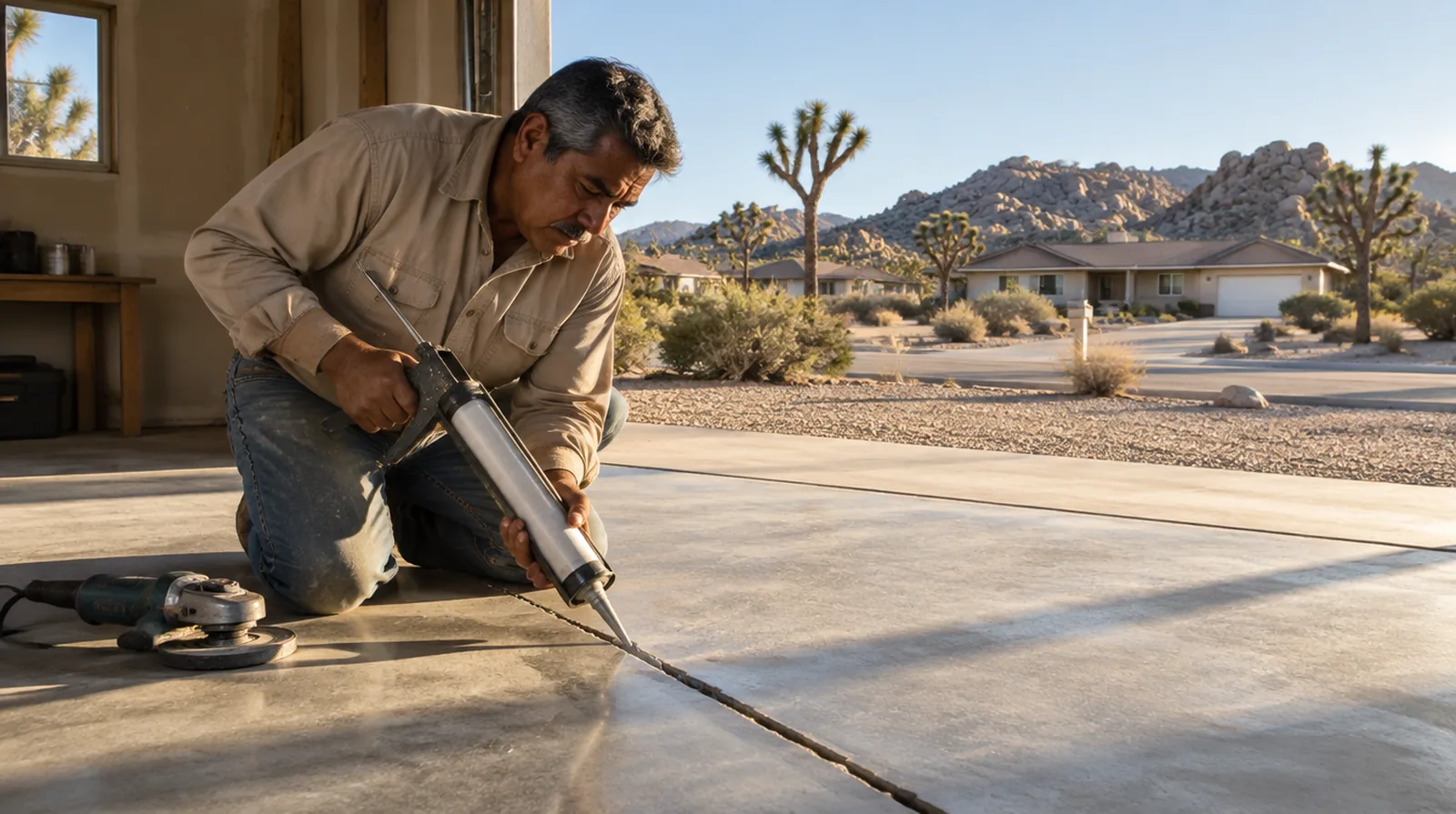
Apple Valley slabs see big changes between day and night, and between summer and winter. Concrete expands and shrinks with those changes, and over time cracks can open and carry through a coated floor.
Spotting moving cracks
Some cracks stay put, while others move a little with temperature. We look at the width, edges and whether old repairs have broken open. That tells us how to treat each one.
Repair methods
Stable cracks can be filled and ground flush. Moving cracks may need a flexible filler or to be treated as a joint so the coating does not keep breaking over them.
Matching the finish
After a repair, we recoat the area. With flake floors, a matching chip blend helps the repair blend in. With solid colors, a small difference may show.
When a full recoat makes sense
If cracks run across the whole floor or the coating is peeling in several places, a full redo may last longer than patches. We explain both options.
What causes damage
- Temperature swings
- Settling soil under the slab
- Heavy loads near edges
- Thin coatings over poorly prepared concrete
Next steps
Send photos of the cracks and the whole floor. We can tell you what we see before we visit.
Garage door edges and aprons
The slab just inside the garage door often takes the worst of it. Water, sand and temperature changes meet there, and the edge can crumble or crack. We cut back loose concrete, rebuild the edge with repair mortar, and blend the coating so the door area matches the rest of the floor. Fixing this spot early helps keep damage from spreading inward.
Tired of peeling floors?
Call (760) 515-4269 and we will tell you what went wrong.