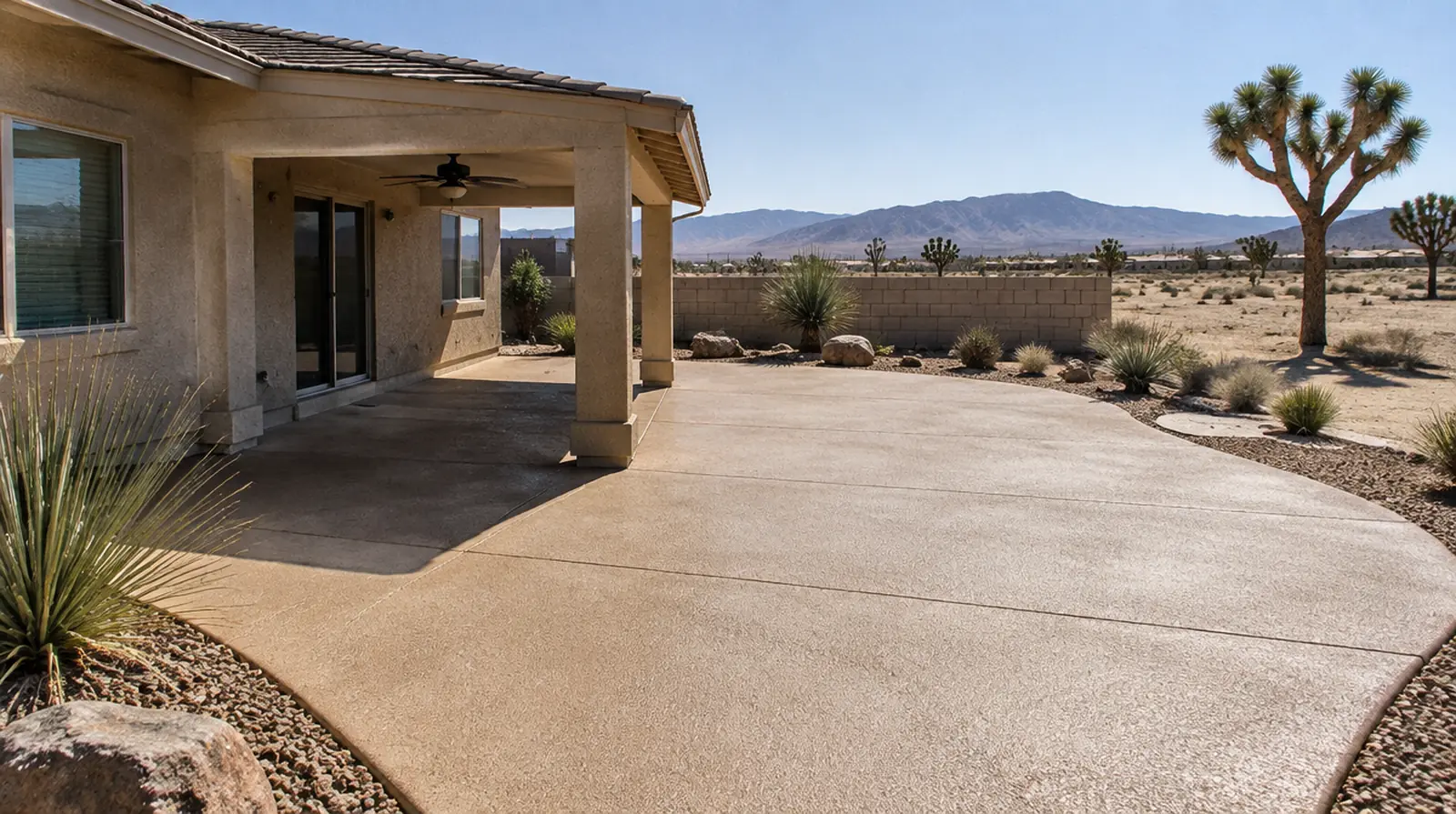
A patio in the high desert
Apple Valley is about 2,900 feet above sea level on the Mojave Desert's high plateau, and the climate is more extreme than coastal Southern California. Summer highs often reach the 100s with almost no humidity. Winter nights can drop below freezing, and the town sometimes sees a dusting of snow. Wind picks up through spring and carries fine sand that scratches thin finishes. Sunlight is strong year-round, and the thin air offers little protection.
Those conditions are tough on concrete. Large daily temperature swings make slabs expand and contract, and cracks run across patios like fault lines. In a desert, rain is rare, but when it falls hard, water finds every crack.
Coatings that handle swings
Many patio coatings are designed for mild, damp places. In Apple Valley we choose materials for dry heat and cold snaps.
- UV-stable topcoats that resist fading and chalking in strong sun.
- Flexible crack fillers that move a little with temperature, not brittle patches that break loose.
- Light, reflective colors to keep surface temperatures lower in July and August.
- A fine non-slip texture that keeps grip on dusty, windblown slabs and on frosty mornings.
Homes and lots we see
Apple Valley has many half-acre and larger lots, and patios here are often big, with room for a swimming pool, a covered area, an RV pad and a barbecue. You will find ranch homes from the 1970s and 1980s, newer tract homes on the edges of town, and custom places near the golf course and the Mojave River. Some homeowners keep horses or have workshops attached to the patio. Block walls surround many yards. Because of that, patio coatings often cover larger areas, and a careful plan avoids lap marks and uneven color.
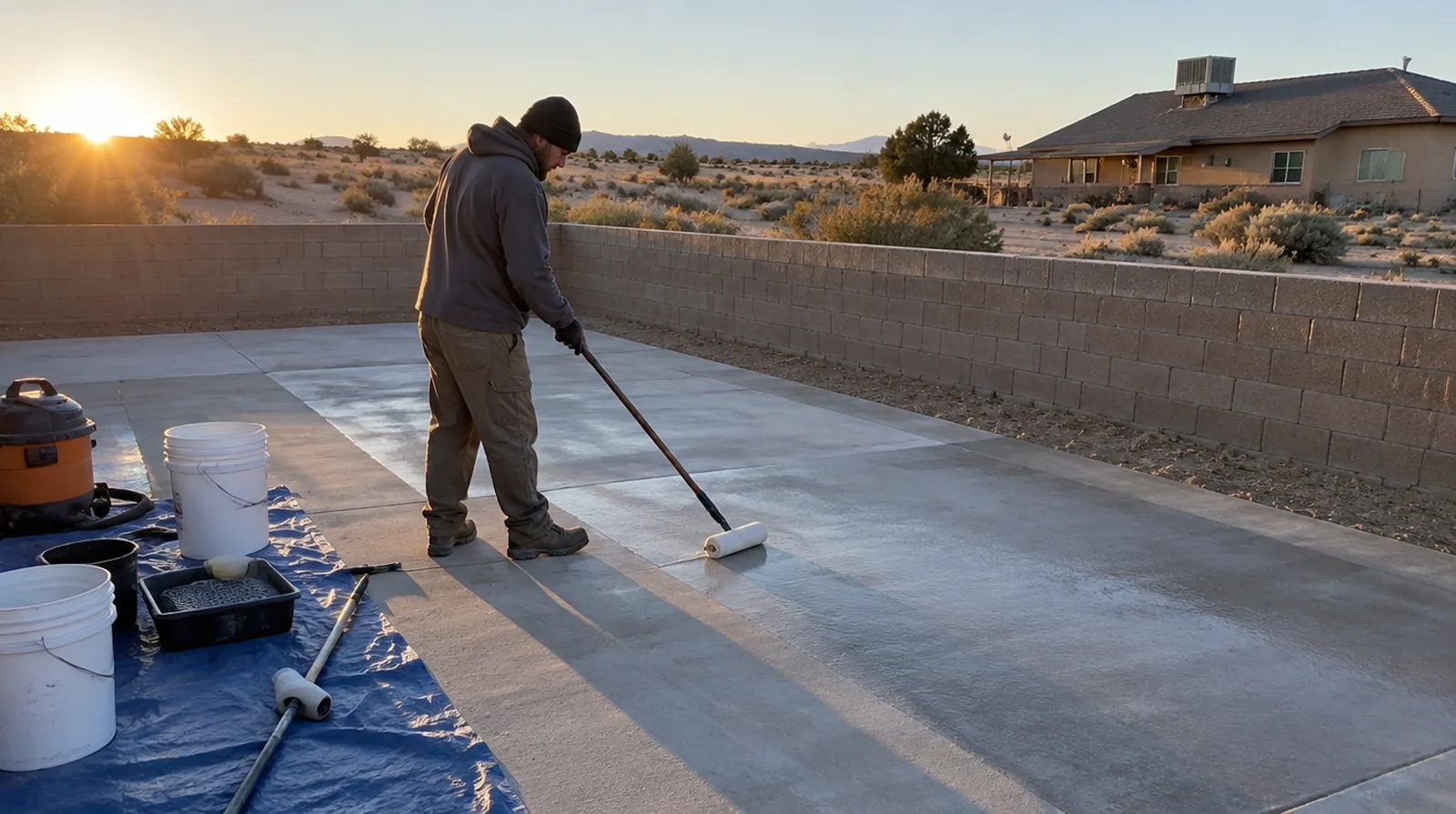
How we get it done
Visit. We check how the slab was poured, whether it has control joints, how deep cracks run and where water drains. Desert slabs often have shrinkage cracks that are cosmetic, and we sort those from real problems.
Grind. A diamond grinder removes sealer and sun-baked paint and opens the pores of the concrete. We vacuum fine sand and dust thoroughly, since dust is the enemy of a good bond.
Fill and prime. Cracks are cleaned and filled with flexible material. A primer soaks in and prevents pinholes as the coating dries.
Coat. Because the air is dry and hot, products can set faster than expected. We start at first light and keep a close eye on slab temperature, which is usually better in the cooler months.
Seal. A clear UV-resistant topcoat finishes the patio.
Best time to coat
Spring and fall are the best seasons, with mild days. Summer jobs are possible with early starts. In winter we plan around freezing nights, because the slab should stay above about 50 degrees while the coating cures. Windy days are a problem as well, since blowing sand can land in wet coating, so we reschedule when gusts pick up.
Water and dust
Rain is rare but heavy when it comes, so check that water runs away from the house. Sweep dust regularly, because abrasive sand wears any surface faster. If you want a simpler protection for plain walkways, see our concrete sealing, and for the driveway ask about driveway coating.
Pools, horses and big projects
Large Apple Valley lots mean larger, multi-purpose slabs. If your patio runs along a pool, ask about our pool deck coating, which uses a grippier texture. Where horses or dogs use the area, we avoid slick finishes and keep the work area clear of animals while it cures. If you have desert landscaping or protected plants like Joshua trees nearby, we mask and protect them, because a stray splash of primer is hard to remove from rock or bark. Large patios are often coated in sections, so the edges do not dry unevenly.
Preparing your patio
Clear furniture, planters and grills from the slab, and let us know about any sprinkler heads or irrigation lines nearby. Wind can blow sand onto a fresh coating, so we ask that you keep the area free of traffic during curing, and we may add temporary wind screens on gusty days.
Common questions
Can we coat over old paint? Only after we grind it off. Paint that is loose will pull the new coating with it.
Does it get hot? Light colors stay cooler than bare concrete or dark paint, though any surface is warm in direct July sun.
Do you serve nearby towns? Yes, including Victorville, Hesperia, Lucerne Valley, Oak Hills and Adelanto.
Plan a desert patio that can take the sun
Call (760) 515-4269. We will look at the slab, talk through color and texture and give you a written price.